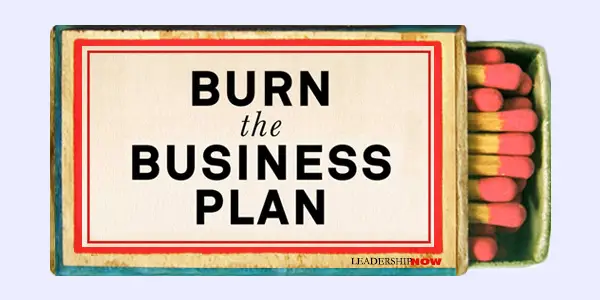
Why You Should Burn Your Business Plan
For generations, the comprehensive, meticulously crafted business plan has been the sacred text of entrepreneurship. It has been the first assignment in business school, the non-negotiable requirement for bank loans, and the foundational document for countless startups. This voluminous document, often spanning 40 to 50 pages, promises a clear, five-year roadmap to success, complete with detailed market analysis, pro-forma financials, and rigid strategic milestones. However, in today’s hyper-competitive, rapidly shifting market landscape, this traditional business plan is not just obsolete—it is actively dangerous. It creates a false sense of security, fosters rigidity in the face of change, and wastes one of a startup’s most precious resources: time. This is a call to action to burn your static business plan and embrace a more dynamic, responsive, and ultimately successful approach to building a business in the 21st century.
A. The Fundamental Flaws of the Traditional Business Plan
The classic business plan is built on a flawed foundation of predictability and control—two things that are virtually non-existent in the early stages of a venture.
A.1. The Illusion of Predictability and a Static Market
A traditional plan operates under the assumption that the future is reasonably predictable. It demands that you forecast revenue five years out, predict customer acquisition costs with precision, and map out a competitive landscape that will remain static.
-
The Reality of Market Volatility: In reality, markets are dynamic ecosystems. A new competitor can emerge overnight. A global pandemic can disrupt supply chains. Consumer preferences can shift in an instant based on a viral social media trend. A 50-page document written in January is often completely irrelevant by June. The plan becomes a work of fiction, yet founders feel compelled to follow it because it exists, leading them down a path that is no longer aligned with reality.
-
False Sense of Security: The very act of creating a detailed plan can breed complacency. Founders feel they have “figured it out” and become less observant, less curious, and less responsive to the subtle feedback the market is providing. They execute the plan instead of engaging with the market.
A.2. The Sunk Cost Fallacy and Institutional Rigidity
Human psychology is wired to follow through on investments of time, effort, and money—a cognitive bias known as the “sunk cost fallacy.” A traditional business plan, by virtue of being a significant investment of time and energy, becomes a psychological anchor.
-
Resistance to Pivoting: When market feedback indicates that your initial idea is flawed, the correct entrepreneurial response is to pivot—to make a fundamental change to your product, business model, or target market. However, a founder holding a beautifully bound business plan is far less likely to pivot. They have already committed to a specific path, and abandoning it feels like admitting failure, even when it’s the smartest strategic move.
-
The “Plan-as-Law” Mentality: In organizations with multiple stakeholders, the business plan can become a de facto law. Employees are tasked with executing the plan’s objectives, and their performance is measured against its milestones. This creates an internal culture that is resistant to change and punishes deviation, even when that deviation is necessary for survival.
A.3. The Misallocation of Precious Time and Resources
For an early-stage startup, time is the ultimate currency. The weeks or months spent researching, writing, and polishing a formal business plan represent an enormous opportunity cost.
-
Analysis Paralysis: The pursuit of perfect data for a business plan can lead to “analysis paralysis,” where founders are stuck in a perpetual cycle of research and planning, afraid to take the first step until every variable is accounted for. Meanwhile, a competitor with a leaner approach is already in the market, learning from real customers.
-
Building in a Vacuum: Time spent writing a plan is time not spent talking to potential customers, building a prototype, or making a first sale. The plan is built on hypotheses and assumptions that have not been validated. It is essentially building a detailed blueprint for a house without first checking if the ground is stable.
 B. The Modern Alternative: A Toolkit for Agile Execution
Burning your business plan does not mean operating without direction or strategy. It means replacing a single, static document with a living, breathing toolkit designed for learning and adaptation.
B.1. The Business Model Canvas: A One-Page Strategic Powerhouse
The Business Model Canvas, developed by Alexander Osterwalder, is the modern antidote to the bulky business plan. It is a single-page visual chart that describes the logic of how a company creates, delivers, and captures value. It forces clarity and conciseness on nine key building blocks:
-
Customer Segments: Who are you creating value for?
-
Value Propositions: What problem are you solving for them?
-
Channels: How do you reach them?
-
Customer Relationships: What type of relationship do you establish?
-
Revenue Streams: How do you make money?
-
Key Activities: What strategically important things must you do?
-
Key Resources: What unique assets do you require?
-
Key Partnerships: Who are your key suppliers and partners?
-
Cost Structure: What are your major costs?
The power of the Canvas lies in its fluidity. It can be sketched on a whiteboard, discussed with a team, and updated in minutes as you learn new information. It is a living document, not a fossilized one.
B.2. The Lean Startup Methodology: Build, Measure, Learn
Popularized by Eric Ries, the Lean Startup methodology provides the operational framework for an adaptive strategy. It is a scientific approach to creating and managing startups that gets a product into customers’ hands as quickly as possible to test foundational hypotheses.
-
The Build Phase: Instead of building a fully-featured product, you create a Minimum Viable Product (MVP). This is the simplest version of your product that can still deliver your core value proposition and provide meaningful learning from early adopters.
-
The Measure Phase: You release the MVP to a small group of users and rigorously collect data on their behavior. How do they use it? What do they ignore? What frustrates them? This moves you from subjective opinion to objective, data-driven insight.
-
The Learn Phase: Based on the data, you validate or invalidate your initial hypotheses. This learning informs your next step: do you persevere on the current path, or do you pivot to a new direction? This creates a continuous feedback loop that ensures you are always building what the market actually wants.
B.3. The Focus on a Rolling 90-Day Action Plan
Instead of a five-year plan, high-growth companies operate on a rolling 90-day (or quarterly) action plan. This plan is tactical, not strategic, and answers the question: “What are the most critical things we must accomplish in the next 90 days to test our biggest assumptions and move the needle?” This could include goals like:
-
“Acquire 100 paying beta users.”
-
“Achieve a 40% trial-to-paid conversion rate.”
-
“Secure meetings with three key potential enterprise partners.”
This short-term focus creates urgency, allows for rapid course correction, and ensures the entire team is aligned on immediate, impactful priorities.

C. When a Formal Document is Still Necessary (and How to Adapt)
While the “burn it” mentality is crucial for the early, exploratory phase, there are specific situations where a more formal document is required. However, even then, its purpose and nature are different.
C.1. The Fundraising Pitch: A Concise Narrative, Not a Tome
When seeking investment from venture capitalists or angel investors, you need a pitch deck, not a 50-page plan. A compelling pitch deck is a visual presentation, typically 10-15 slides, that tells a powerful story:
-
The Problem
-
The Solution
-
The Market Opportunity
-
The Business Model
-
The Underlying Magic (Technology/Product)
-
The Marketing & Sales Strategy
-
The Competitive Landscape
-
The Team
-
The Financial Projections & Ask
The financial projections here are not a five-year budget. They are a model that shows you understand your key unit economics—Customer Acquisition Cost (CAC), Lifetime Value (LTV), and gross margins—and can articulate a plausible path to scale.
C.2. Strategic Planning for Established Businesses
For a mature, stable company with a proven business model, a more formal annual operating plan is useful. However, this should still be a dynamic tool. It should be reviewed quarterly and adjusted based on performance and changing market conditions. It is a guide, not a gospel.
D. Implementing the “Plan-Less” Strategy: A Practical Guide
Shifting from a plan-centric to a learning-centric model requires a change in daily habits and mindset.
D.1. Get Out of the Building: The Primacy of Customer Development
Steve Blank’s famous mantra, “Get Out of the Building,” is the cornerstone of this approach. Your strategy cannot be developed in a conference room. It must be discovered through conversations with potential customers, partners, and suppliers. This is a systematic process of testing your hypotheses in the real world.
D.2. Embrace Experimentation as a Core Discipline
Treat every strategic initiative as an experiment. Frame it with a clear hypothesis: “We believe that by [doing this], for [these customers], we will achieve [this outcome].” Then, design the simplest possible test to validate or invalidate that hypothesis. This could be a landing page test, a series of customer interviews, or a Wizard of Oz prototype (a manual process that looks automated to the user).
D.3. Cultivate a Culture of Learning, Not Execution
As a leader, you must reward learning, even when the learning is that your initial idea was wrong. A team that successfully runs an experiment that kills a bad idea has saved the company thousands of dollars and months of wasted effort. They should be celebrated, not punished. Shift your key performance indicators from purely output-based (e.g., “launch feature X”) to learning-based (e.g., “validate or invalidate customer assumption Y”).
Conclusion: From Static Blueprint to Dynamic Compass
The choice is no longer between having a plan and having no plan. The choice is between a static blueprint that is wrong the moment it is printed and a dynamic compass that guides you through the unpredictable terrain of the market.
Burning your business plan is a symbolic act of liberation. It frees you from the shackles of a predetermined path and empowers you to become a true explorer—to listen, to adapt, and to discover a business that is truly fit for the world as it is, not as you imagined it would be. Embrace the tools of agility: the Business Model Canvas, the Lean Startup loop, and the 90-day action plan. In the modern economy, the ability to learn and adapt is the only sustainable competitive advantage. Stop writing fiction and start discovering your facts. Your future, successful business will thank you for it.
Category: Entrepreneurship
Tags: business plan, entrepreneurship, startup strategy, agile methodology, lean startup, business model canvas, startup failure, pivoting, business strategy, minimum viable product, customer development, adaptive planning, startup funding, iterative process